newdemo.thefortuneleader.com

Category: Blogs

  • Embedl sets a new standard for on-device LLM inference, releasing the world’s fastest language models for the edge.

    Embedl sets a new standard for on-device LLM inference, releasing the world’s fastest language models for the edge.

    Gothenburg, Sweden — December 8, 2025

    Embedl, a Swedish deep-tech pioneer in AI model optimization, announced today FlashHead, an optimization method that makes the most popular language models, including Llama-3.2 (Meta), Gemma-3 (Google DeepMind), and Qwen-3 (Alibaba), the fastest models for on-device inference.

    The technology, “FlashHead: Efficient Drop-in Replacement for the Classification Head in Language Model Inference,”  reduces latency by up to 43% while preserving full model accuracy.

    “FlashHead eliminates a major AI deployment bottleneck,” says Hans Salomonsson, CEO of Embedl. “ This means world class SLM models now run at lightning speed on everyday devices; fast, compact, and sustainable.”

    A Revolution in Language Model Efficiency

    Today’s classification head predicts the next token by assigning a probability to all possible tokens, but it is resource-intensive. State-of-the-art models include hundreds of thousands of possible tokens in their vocabularies, causing the head to become a severe bottleneck for inference. FlashHead reformulates a language model through the lens of information retrieval, making it faster and less computationally demanding. Notably, FlashHead delivers these efficiency gains while leaving the model’s output virtually unchanged.

    FlashHead achieves this through several innovations, including equal-sized clustering for fast memory access, multi-probe retrieval, probabilistic sampling for increased speed, and selective quantization.

    1. Equal-sized clustering for fast memory access.
    2. Multi-probe retrieval to evaluate multiple token clusters efficiently.
    3. Probabilistic probe sampling for accurate, high-speed decoding.
    4. Selective quantization for robust low-bit computation without accuracy loss.

    These optimizations make the classification head a minor cost, enabling fast inference even on low-power devices.

    Proven Across Model Families

    FlashHead has been tested on several of the world’s most widely used open models:

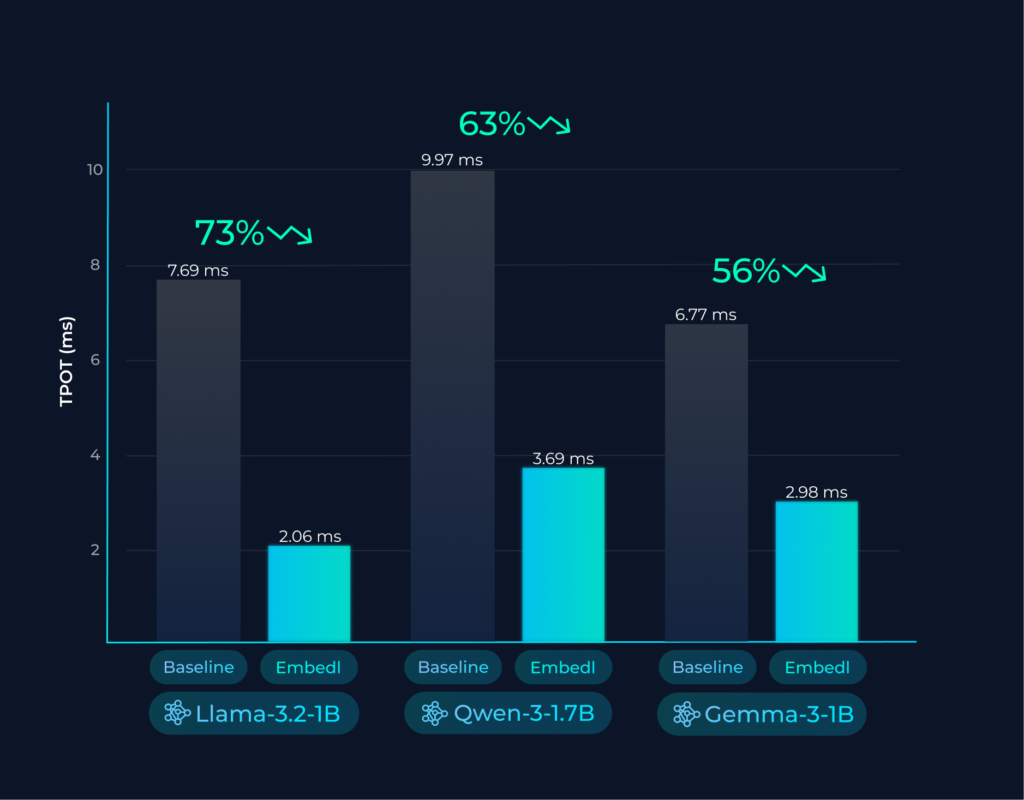
    • Llama-3.2-1B (Meta)  43% Latency Reduction
    • Gemma-3-270M (Google DeepMind)  26% Latency Reduction
    • Qwen-3-1.7B (Alibaba)  24% Latency Reduction

    These speedups are in relation to state-of-the-art optimization (w4A16 quantization). When combined with mixed precision optimization, the Embedl optimized Llama 3.2-1B for RTX 3500 Ada Generation reaches almost the same latency (2.06 ms) as the original model on the much more powerful H200 GPU (1.95 ms),, enabling true on-device AI.

    Available December 8 on Hugging Face

    Starting December 8, 2025, developers and researchers can access and use optimized FlashHead models for Llama-3.2, Gemma-3, and Qwen-3 on Hugging Face. Visit Hugging Face to try FlashHead and experience its efficiency improvements firsthand.

    “This milestone makes state-of-the-art models run faster, cheaper, and locally for everyone, no cloud required,” says Hans Salomonsson.

    About Embedl

    Embedl AB is a Swedish company specializing in AI optimization. Embedl delivers solutions to make AI models faster, smaller, and more energy-efficient, powering high-performance AI on any Edge device.

    Media Contact:

    Press Embedl AB

    frida@embedl.com |  www.embedl.com
  • Italy Redefines Global Luxury Hospitality with Timeless Elegance

    Italy Redefines Global Luxury Hospitality with Timeless Elegance

    Italy is truly redefining what luxury hospitality means, blending timeless elegance with modern innovation to set new benchmarks on a global scale. From charming historic villas and picturesque lakeside palazzos to cutting-edge coastal resorts, the country beautifully demonstrates how heritage, craftsmanship, and contemporary design can come together to create unforgettable experiences for guests.

    The Italian luxury hotel scene has really taken off in recent years, thanks to strong investments and a growing global appetite for upscale travel. These high-end properties now make up a big chunk of Italy’s overall hospitality earnings, with occupancy rates and average daily prices consistently outshining their regional rivals. Both investors and operators are placing their bets on Italy’s unique blend of cultural richness, stunning architecture, and world-class cuisine as key factors for future growth.

    When it comes to luxury, Italy is stepping up its game by focusing on authenticity and unforgettable experiences. Hotels are now offering unique local adventures, from private vineyard tours and artisan workshops to wellness retreats that embrace Mediterranean traditions. This hands-on approach is perfect for today’s travelers who crave cultural immersion just as much as they do comfort and exclusivity.

    Wellness and sustainability have truly become key elements in today’s luxury scene. Many high-end properties are now embracing eco-friendly designs, serving up organic dishes, and offering innovative spa experiences that beautifully merge ancient healing traditions with cutting-edge technology. This transformation is part of a broader global movement towards mindful luxury, and Italy is mastering it with remarkable skill.

    These days, it is not just Rome, Venice, and Florence stealing the spotlight. Places like the Amalfi Coast, Puglia, Lake Como, and Tuscany are becoming the new go-to spots, with a wave of boutique luxury developments popping up. This shift is not only helping to lighten the load on the big tourist cities but also highlighting the incredible diversity that Italy has to offer.

    When you look at the bigger picture, Italy’s hospitality model has really set the standard for the industry around the globe. Its knack for blending tradition with innovation, and a touch of glamour with genuine authenticity, is inspiring brands and investors far and wide.

  • Where Heritage Meets Luxury: The Middle East’s New Era of Hospitality

    Where Heritage Meets Luxury: The Middle East’s New Era of Hospitality

    The Middle East is transforming the world of hospitality by beautifully integrating its rich cultural heritage with modern luxury. From Saudi Arabia to the UAE and Qatar, a fresh wave of hotels and resorts is emerging, skillfully combining tradition with innovative design. This offers guests more than just a place to stay; it provides a deep dive into a heritage that spans centuries.

    As tourism continues to flourish and become a key player in economic diversification, Gulf nations are pouring resources into projects that celebrate their rich heritage while catering to the modern traveler’s quest for authenticity. Take Saudi Arabia’s Vision 2030, for example; it has ignited a wave of architectural innovation through the restoration of historical sites and adaptive reuse, turning ancient forts, desert oases, and historic trading posts into top-notch destinations.

    In Dubai and Abu Dhabi, you will find charming boutique hotels that draw inspiration from the region’s rich heritage, beautifully contrasting with the modern skyline. These unique properties showcase local art, traditional craftsmanship, and materials sourced right from the area, creating a true sense of place. Picture courtyards shaded by swaying palm trees, intricately hand-carved wooden mashrabiya screens, and Arabian motifs, all reimagined with a contemporary twist. This blend of elegance and authenticity perfectly captures the evolving identity of hospitality in the region.

    Culinary innovation is a vital part of this transformation. Restaurants in heritage hotels are increasingly showcasing modern interpretations of traditional Middle Eastern flavors, using local ingredients and crafting menus that tell stories and honor regional heritage.

    Industry experts highlight that the real charm comes from this unique blend of luxurious comfort and rich cultural depth. Nowadays, guests are not just after extravagance; they are looking for meaning, connection, and a story to tell.

    Challenges still exist, from the steep costs of restoration to the need to preserve cultural integrity in the face of commercialization. However, as the region skillfully merges its rich heritage with modern innovation, it is setting a new standard for luxury travel worldwide one where the past enhances the present, and every visit unfolds a unique story.

  • The Rise of Smartrooms: Redefining Learning with AI

    The Rise of Smartrooms: Redefining Learning with AI

    The traditional classroom, once characterized by chalkboards, textbooks, and in-person lessons, is experiencing a remarkable shift. With artificial intelligence (AI) transforming industries around the globe, education is moving away from rigid, one-size-fits-all teaching methods and embracing a more dynamic, data-driven approach that caters to the unique needs of each student. The emergence of “smartrooms” signals a new chapter where technology and education come together to foster more engaging, inclusive, and effective learning environments.

    At its heart, using AI in education is all about making learning personal. Every student has their own unique way of grasping information some thrive with visuals, while others learn best through hands-on practice or engaging discussions. Thanks to AI-driven learning platforms, we can now track a student’s progress in real time, pinpointing their strengths and weaknesses, and then tailoring the content to match their individual learning style. This kind of customization makes sure that every student gets the support they need, while also keeping advanced learners on their toes with new challenges

    Teachers are discovering that AI can be a fantastic partner in their work. These smart systems can take care of those tedious administrative tasks like grading assignments, keeping track of attendance, and analyzing performance data. This gives educators more time to focus on what really matters: teaching and mentoring their students. Plus, tools like AI-driven chatbots are there to help students even after school hours, answering questions, providing study materials, and giving instant feedback.

    AI is not just about being efficient; it’s also transforming the way we learn by making it more engaging. In smart classrooms, technologies like virtual reality (VR) and augmented reality (AR) are being integrated, all thanks to AI algorithms. These innovative tools allow students to dive into complex topics in a hands-on way whether it’s dissecting a virtual frog, exploring the solar system, or wandering through historical landmarks. These kinds of experiences not only make learning stick but also help connect the dots between theory and real-world application

    AI is truly breaking down barriers when it comes to accessibility. Thanks to advancements in speech recognition, translation, and adaptive learning tools, students with disabilities or those who speak different languages can now interact with educational content in ways that cater to their unique needs. This push for inclusivity is playing a vital role in democratizing education, ensuring that quality learning opportunities are available to a wider audience across the globe.

    As AI becomes a regular part of the classroom, it brings up some crucial questions about privacy, ethics, and the role of human teachers. The future of education needs to find a way to blend technological advancements with the empathy, creativity, and critical thinking skills that only humans can offer.

    From traditional classrooms to cutting-edge smartrooms, AI is not here to take over the role of teachers; it is here to uplift them. It is reshaping education into a more personalized, engaging, and inclusive journey, equipping students not just to ace their exams, but to flourish in a world where technology and humanity evolve together.

  • ChatGPT Opens In-App Shopping for Users

    ChatGPT Opens In-App Shopping for Users

    ChatGPT, the popular conversational AI platform, has just rolled out an exciting new feature that lets users shop right from the app. This development is a big leap forward, turning it from just a chat assistant into a fun and interactive shopping buddy!

    The latest update allows users to browse products, compare different options, and make purchases all without ever leaving the chat interface. By adding e-commerce features,  ChatGPT is transforming from just an AI that answers questions or creates content into a real gateway for online shopping.

    The shopping feature is designed to be super user-friendly. When someone shows interest in purchasing something be it a gadget, a book, or a piece of clothing ChatGPT can now present tailored options right away. These results come complete with product details, prices, and availability, making it easy for users to compare their choices quickly. Once they have planned, users can smoothly navigate through the checkout process all within the same platform.

    Industry experts believe this move is a natural evolution for conversational AI. By combining information retrieval with commerce, ChatGPT is effectively connecting digital assistance with real-world consumer actions. For retailers, this integration creates exciting new opportunities to engage customers through AI-driven recommendations that are customized based on individual preferences and previous behaviors.

    For users, the real advantage is all about convenience. Instead of hopping between different search engines, shopping apps, and payment platforms, they can now handle everything in a single conversation. This smooth experience is likely to resonate particularly well with younger consumers who are used to quick, mobile-first shopping.

    While the expansion brings exciting opportunities, it also sparks important discussions around data privacy, advertising, and the evolving role of AI in the world of commerce. Critics are calling for more transparency regarding how algorithms choose and showcase products. As this feature continues to grow, ensuring a level playing field for all sellers will be a crucial factor to keep in mind.

    The launch really highlights how quickly AI is moving beyond just being an informational tool and is becoming a go-to platform for our everyday tasks. Now that you can shop right within the chat, ChatGPT is making its mark in one of the most profitable sectors of the digital economy.

  • Automation to Intelligence: The Next Frontier of Mining Technology

    Automation to Intelligence: The Next Frontier of Mining Technology

    The mining industry, which used to be all about heavy machinery and hard manual work, is now undergoing a major transformation thanks to artificial intelligence (AI). With the global appetite for minerals and metals on the rise, mining companies are increasingly turning to AI to boost efficiency, enhance safety, and promote sustainability at every stage of their operations. From the initial exploration to extraction and processing, AI is changing the way we discover, develop, and deliver these vital resources.

    One of the most impactful ways AI is transforming the mining industry is through exploration and resource discovery. Traditionally, exploration has been a lengthy and expensive process, often requiring extensive surveys and drilling. However, with the help of AI-driven data analytics, companies can now sift through massive geological datasets to spot potential mineral deposits with much greater precision. Machine learning algorithms can analyze satellite images, seismic data, and geochemical trends to identify the area’s most likely to yield success, ultimately cutting down on exploration costs and minimizing environmental impact.

    Once operations kick off, AI takes center stage in fine-tuning extraction and production processes. With smart sensors and autonomous equipment driven by AI, machinery performance and site conditions are monitored in real time. These advanced systems can foresee equipment failures before they occur, helping to cut down on downtime and maintenance expenses. We are seeing more autonomous haul trucks and drilling rigs in action, working with impressive precision, and reducing the need for humans to be in risky areas.

    AI is revolutionizing safety management, which is a top concern in the mining industry. With the help of intelligent monitoring systems that leverage computer vision and predictive analytics, potential safety hazards can be identified ranging from structural weaknesses to unsafe behaviors among workers. These early-warning systems empower companies to act quickly, helping to prevent accidents and prioritize the well-being of their employees.

    In the world of processing and refining, AI is a game changer for boosting efficiency and sustainability. It does this by fine-tuning energy consumption, managing waste, and streamlining chemical processes. With the help of machine learning models, companies can analyze ore grades and automatically tweak processing parameters, which not only enhances yield but also minimizes environmental impact. Plus, AI-powered systems for managing water and energy are essential for helping businesses achieve their sustainability targets and stay in line with environmental regulations.

    AI is not just about making things run smoothly; it also plays a crucial role in helping leaders make smart decisions by transforming data into practical insights. By pulling together information from every part of the value chain, executives can confidently tackle decisions related to production planning, logistics, and market forecasting.

    While there are still hurdles to overcome, like the hefty costs of implementation and the challenges of data integration, the potential of AI in mining is truly remarkable. The future of the mining industry will be shaped not just by automation, but by smart technology that learns, adapts, and collaborates with humans to create a safer, more intelligent, and sustainable environment.

  • Success Through Connection: The Hidden Value Of Networking For Women Entrepreneurs

    Success Through Connection: The Hidden Value Of Networking For Women Entrepreneurs

    In the contemporary, rapidly evolving, and intensely competitive landscape, networking serves as an essential instrument for achieving success in the business realm. For women entrepreneurs, the significance of cultivating robust professional relationships extends beyond mere connection; it involves establishing a supportive community that empowers, mentors, and drives them toward their goals. Networking transcends the simple act of exchanging business cards or participating in industry gatherings. It focuses on forging authentic, meaningful relationships that encourage mutual development, and for women entrepreneurs, such a network can be transformative.

    The Power of Women Supporting Women

    A significant advantage of networking for women entrepreneurs lies in the ability to engage with other women who comprehend the distinct challenges they encounter. These challenges may include managing work-life balance, addressing bias, or dealing with restricted access to funding. By forming a network of fellow female entrepreneurs, women can cultivate an environment conducive to sharing experiences, insights, and resources, while also offering crucial emotional and professional support.

    Historically, women have faced significant underrepresentation in the field of entrepreneurship, with their access to financial resources and networking opportunities frequently constrained. Networking serves as a vital tool in addressing this disparity by linking women to prospective investors, mentors, and colleagues who can facilitate new opportunities. Additionally, through networking, women can enhance their visibility and establish credibility, thereby simplifying the process of attracting new clients, partners, and employees.

    Mentorship and Guidance

    An additional significant benefit of networking is the chance to connect with mentors who can share their guidance and insights derived from personal experiences. Accomplished women entrepreneurs, who have successfully faced the hurdles of establishing a business, can impart crucial advice, motivation, and understanding. Mentorship plays a vital role in surmounting challenges, particularly for women who might lack access to conventional support systems. A mentor can deliver valuable feedback, assist in the decision-making process, and offer a new viewpoint on business-related issues.

    Mentorship encompasses more than merely obtaining guidance; it also involves contributing to the growth of others. As women entrepreneurs progress in their careers, they can support the next generation of female business leaders by providing mentorship. This fosters a robust cycle of encouragement, enabling women to uplift each other, thereby dismantling obstacles and reshaping the definition of success.

    Expanding Opportunities Through Networking

    Establishing a network facilitates access to new business prospects. The relationships that women cultivate can lead to potential collaborators, partners, and clients who align with their values and objectives. By participating in networking events, engaging with industry-specific organizations, or leveraging social media platforms, women can expand their influence and explore new markets. Such connections may result in strategic alliances, business referrals, and investment opportunities that might not be accessible through conventional business avenues.

    The Bottom Line: Strength in Numbers

    Networking fundamentally revolves around establishing a community that provides support, guidance, and opportunities. For women entrepreneurs, the significance of networking extends beyond mere idea exchange; it involves cultivating enduring relationships that promote growth, collaboration, and success. By engaging with fellow women, sharing insights, and providing assistance, women entrepreneurs can discover untapped opportunities and create pathways for enhanced accomplishments.

  • The Future of Commercial Real Estate: Co-Working And Hybrid Workspaces

    The Future of Commercial Real Estate: Co-Working And Hybrid Workspaces

    The commercial real estate (CRE) sector has undergone considerable transformations in recent years, driven by evolving workforce dynamics, technological innovations, and a global pandemic that has altered the nature of work and its locations. In response to these shifting trends, co-working spaces and hybrid work models are increasingly becoming popular. These developments are redefining the future of commercial real estate, significantly impacting office space utilization, leasing strategies, and urban environments.

    The Rise of Co-Working Spaces

    Co-working spaces were experiencing a rise in popularity prior to the pandemic; however, the transition to remote work in 2020 significantly expedited their acceptance. These spaces provide adaptable, communal office environments where organizations of varying sizes, ranging from independent contractors to large corporations, can rent desks or private offices for both short and extended periods. Prominent companies in this sector, including WeWork, Regus, and Spaces, have played a crucial role in setting a new benchmark for office flexibility, presenting a range of work environments that cater to different requirements.

    The appeal of co-working spaces is rooted in their adaptability and economic efficiency. Companies are no longer required to enter into lengthy lease agreements or incur the substantial expenses associated with managing extensive office facilities. Rather, they have the option to rent a modest segment of a communal office space, allowing them to adjust their space requirements in accordance with their evolving needs. This represents a significant advantage for startups and small enterprises, as it provides them with the opportunity to utilize premium office settings without the financial burden typically associated with conventional office leases.

    Hybrid Workspaces: The New Normal

    Hybrid work models, which combine remote work with in-office attendance, are gaining popularity. Surveys indicate that a considerable segment of the workforce values the option to work from home on a part-time basis while retaining a physical presence in the office for team collaboration, meetings, and brainstorming activities. This transition is prompting organizations to reassess their office space needs, shifting from conventional, static office designs to more adaptable and flexible work environments.

    Hybrid workspaces generally feature adaptable office configurations that enable employees to select their preferred work environment, whether it be from home, a co-working facility, or a conventional office setting. These environments are tailored to accommodate the diverse requirements of hybrid workers, offering options such as hot-desking, collaborative workspaces, quiet areas for concentrated tasks, and access to cutting-edge technology for virtual meetings.

    Impact on Commercial Real Estate

    As co-working and hybrid work environments become increasingly popular, conventional office leasing models are undergoing significant transformation. Numerous organizations are reducing their office space in favor of more flexible options, choosing co-working facilities, or leasing smaller, more versatile offices that can support hybrid teams. This shift is particularly noticeable in large metropolitan areas, where the rates of office vacancies have increased as companies adjust their spatial needs.

    Commercial real estate developers and property owners are progressively redirecting their attention towards adaptability and technological advancements. To maintain a competitive edge, office buildings are required to provide a variety of amenities that cater to hybrid workers, including high-speed internet, video conferencing capabilities, on-demand meeting rooms, and access to collaborative workspaces.

    The Future Outlook

    The future landscape of commercial real estate is expected to embrace a hybrid model, integrating conventional office spaces with adaptable co-working environments to cater to the varied requirements of businesses and their workforce. Organizations will maintain a focus on flexibility, and co-working providers will be crucial in offering dynamic workspaces that support hybrid work arrangements.

    As the global landscape adjusts to the realities following the pandemic, the commercial real estate sector is likely to encounter additional challenges. Innovations in technology, shifts in employee preferences, and the transformation of workplace standards will significantly influence the commercial real estate market. It is evident that the future of this industry will be increasingly characterized by a demand for flexibility, a sense of community, and the capacity to respond to the continuously evolving nature of work.

  • Sustainable Living: The Growing Demand For Eco-Friendly Homes

    Sustainable Living: The Growing Demand For Eco-Friendly Homes

    As the climate crisis intensifies, there is an increasing recognition of the environmental consequences of human actions. One of the sectors experiencing a notable change due to this evolving perspective is the housing industry, which is witnessing a substantial increase in the demand for environmentally friendly homes. This trend, commonly known as sustainable living, emphasizes the importance of minimizing carbon emissions, preserving natural resources, and enhancing the overall ecological well-being of our planet. It is essential to examine the reasons behind the rising popularity of eco-friendly homes and to consider the prospects of sustainable living.

    The Rise of Environmental Awareness

    In recent decades, the impacts of climate change have become more evident, manifesting in phenomena such as rising sea levels, severe weather events, habitat destruction, and deforestation. These pressing issues have compelled both individuals and governments to reconsider their lifestyle choices and practices, especially concerning homeownership. While numerous individuals are adopting sustainable practices in their everyday lives, including the use of electric vehicles and waste reduction, the subsequent logical progression is the adoption of environmentally friendly homes.

    What Are Eco-Friendly Homes?

    Eco-friendly residences, often referred to as sustainable or green homes, are created with environmental considerations at the forefront. These dwellings are built utilizing sustainable construction materials, energy-efficient devices, and renewable energy options such as solar energy. Additionally, they emphasize waste reduction and the incorporation of recycled and natural materials.

    Key features of eco-friendly homes include:

    Energy Efficiency: Eco-friendly residences are constructed with the aim of reducing energy usage by incorporating superior insulation, energy-efficient windows, and state-of-the-art HVAC systems. This approach contributes to decreased dependence on fossil fuels, lower energy expenses, and a reduced carbon footprint for the home.

    Solar Panels: Numerous eco-friendly residences integrate solar energy systems, enabling homeowners to produce their own electricity from a renewable resource. The installation of solar panels can greatly lower energy expenses and enhance the overall sustainability of a home.

    Water Conservation: Sustainable residences typically incorporate water-efficient appliances, low-flow fixtures, rainwater collection systems, and effective irrigation methods. These initiatives contribute to the conservation of water resources, which are becoming progressively limited in numerous areas.

    Sustainable Materials: Eco-friendly residences are built with materials that are either renewable, recycled, or sourced from local suppliers. Utilizing such materials minimizes the environmental effects associated with construction and decreases the carbon footprint of the structure.

    Why the Growing Demand?

    Climate Change Awareness: As media attention and scientific research highlight the harmful impacts of climate change, a growing number of individuals are taking initiative to minimize their environmental impact. Opting for sustainable housing allows people to make concrete contributions to combating the climate crisis.

    Government Incentives: Numerous governments globally provide incentives to encourage homeowners to invest in sustainable living practices. Such incentives may encompass tax reductions, financial support for the installation of solar panels, and rebates for purchasing energy-efficient appliances. These measures significantly reduce the financial burden on individuals seeking to construct or upgrade their homes with environmentally friendly features.

    Health and Well-being: Eco-friendly homes not only address environmental concerns but also foster healthier lifestyles. The incorporation of non-toxic materials, enhanced air quality, and abundant natural light contributes to better physical and mental health. There is a growing recognition among individuals that their living conditions significantly impact their overall well-being.

    Aesthetic and Modern Appeal: Numerous environmentally conscious residences also attract a sense of elegance and contemporary lifestyle. Featuring sleek lines, expansive windows, and a focus on natural illumination, sustainable homes frequently integrate harmoniously with their surroundings, offering a tranquil and enjoyable living environment. As design trends progress, an increasing number of homeowners are opting for eco-friendly houses due to their practicality and visual appeal.

    The Future of Sustainable Homes

    Eco-friendly residences represent more than a fleeting trend; they are an essential element in the battle against climate change. By minimizing energy usage, preserving water resources, and employing sustainable materials, these homes contribute significantly to fostering a more sustainable future for everyone. The increasing interest in eco-friendly homes, driven by environmental awareness, cost savings, or the pursuit of healthier living environments, signifies a shared aspiration to coexist harmoniously with the Earth.

  • Hackers Use Google Drawings in New 3-Step Amazon Phishing Attack

    Hackers Use Google Drawings in New 3-Step Amazon Phishing Attack

    Cybercriminals’ strategies are constantly improving, and a recent phishing attempt on Amazon users exemplifies their unique approach. Hackers are now using Google Drawings as part of a complex three-step phishing attack to fool victims and collect personal data.

    Deceptive Email: The attack begins with a fairly valid email that purports to be from Amazon. This email frequently has an enticing subject line, such as “Important Account Update” or “Security Alert.” It employs recognized branding and language to instill a sense of urgency, urging recipients to take urgent action.

    Google Drawings Exploit: When the user opens the link provided in the email, they are taken to a Google Drawings document. At first sight, the document appears to be a normal file, but it contains a hidden hyperlink or embedded script. This false page is designed to resemble an Amazon login page, gathering user credentials as they are input. Google Drawings is an uncommon target for such assaults because it does not typically elicit quick suspicion from consumers.

    Credential Harvesting: After the user enters their credentials, the phishing site sends the sensitive information to the attackers. The hackers then use the stolen credentials to get illegal access to the victim’s Amazon account, which could result in additional exploitation or financial loss.

    Protective Measures

    To avoid such assaults, users should be wary of unsolicited emails and check the veracity of links before clicking. Ensuring website security and utilizing multi-factor authentication can provide additional layers of defence against phishing attacks. To summarize, this new phishing scam emphasizes the importance of remaining vigilant and aware of developing cyber risks. Understanding and recognizing these strategies allows users to better protect themselves from such sophisticated attacks.