newdemo.thefortuneleader.com

Category: FINANCE

  • The Future Of Wealth Management: 2025’s Must-Have AI Tools

    The Future Of Wealth Management: 2025’s Must-Have AI Tools

    The wealth management industry is undergoing a technological transformation in the year 2025. Artificial intelligence (AI) is emerging as the driving force behind the development of financial services that are more intelligent, faster, and more individualised. Artificial intelligence (AI) solutions that incorporate data analytics, automation, and predictive modelling are gaining popularity among financial advisors, investors, and institutions. These solutions are becoming increasingly popular. The usage of these tools allows for the opening of new opportunities. To influencing the future of wealth management, the following artificial intelligence tools are an absolute necessity.

        1. Intelligent Robo-Advisors

    It is no longer the case that robo-advisors of the future generation are limited to basic portfolio allocation responsibilities. To customise investment plans based on the objectives of an investor, the current market conditions, and a real-time risk assessment, deep learning algorithms are currently being included into investment strategies. This is being done to make the strategies more personalised. Automatic rebalancing of portfolios, optimisation for tax efficiency, and adaptation of strategies in response to changes in economic conditions are all features that are offered by these platforms.

    • Conversational AI Assistants

    Customers can ask questions in everyday language, such as “What is the performance of my portfolio this month?”, and receive instantaneous responses that are tailored to their unique requirements and are driven by data. This is made possible by financial assistants that are powered by artificial intelligence. The public can gain access to more complex financial insights because of these solutions, which bridge the gap between professional advice and user-friendly participation.

     3. Holistic Financial Planning Platforms

    Using contemporary artificial intelligence technology, the processes of financial planning, retirement planning, investment management, and estate administration are all consolidated into a single user interface environment. To provide direction for decision-making throughout one’s entire life, they analyse patterns of spending, offer suggestions for customised strategies for preserving one’s financial resources, and model a variety of alternative financial scenarios. When it comes to families or couples, there are even some that allow for the utilisation of pooled funds and the implementation of collaborative financial planning.

    4.Risk Management & Compliance Automation

    The monitoring of portfolio risks, the identification of transactions that are not normal, and the assuring of regulatory compliance are all areas in which artificial intelligence solutions are already playing a key role. The automated algorithms have the capability to process massive datasets in a matter of seconds, thereby discovering potential issues before they become more serious. Wealth managers can safeguard their clients while simultaneously boosting their efficiency if they integrate risk assessment into their day-to-day operations.

    5.Institutional-Grade Analytics

    Large financial institutions are increasingly turning to the usage of artificial intelligence platforms that can process market data, research reports, and economic indicators in real time. This trend is expected to continue. In addition to supporting advisors in draughting client reports more rapidly and giving them with actionable insights, these technologies also notice developing investing trends, which frees up more time for advisors to engage in customised client engagement.

    Reasons Why It Is Relevant

    The field of wealth management is undergoing a change from a reactive one to a predictive one through the utilisation of artificial intelligence. Although these technologies provide speed, scalability, and precision, human understanding is still required to evaluate data, interpret the feelings of customers, and make judgements that are specific to the circumstance it is being used to.  A hybrid model, notably one that blends artificial intelligence for precision and efficiency with human judgement for trust and empathy, will be the winning formula in the year 2025. This is because the hybrid model will combine the two sets of capabilities.

    In the years to come, those who can accept and adapt to these breakthroughs in artificial intelligence will be in the best position to deliver competitive wealth management services that are centred on the customer in a world of finance that is always evolving. This is because the world of finance is constantly evolving.


  • Essential Practices For Strategic CFO Leadership

    Essential Practices For Strategic CFO Leadership

    Essential Practices for Strategic CFO Leadership

    The role of the Chief Financial Officer (CFO) has undergone significant transformations since the days when it consisted solely of accounting and reporting.   The Chief Financial Officers of today are strategic leaders that assist businesses in coping with economic uncertainty, changes in their industries, and significant growth opportunities.   For them to be successful, they need to be experts in both managing money and communicating with others.   A strategic chief financial officer (CFO) leadership is comprised of five critical components.

    1.Have a mentality that is focused on the future

    In addition to looking at the past, a strategic chief financial officer (CFO) also considers the future and makes plans for a variety of potential outcomes.   By utilising advanced analytics, forecasting tools, and market intelligence, they aid firms in preparing for changes, adjusting quickly, and seizing opportunities before their competitors do so.   For ensuring that financial plans are in accordance with long-term objectives rather than only short-term performance measures, this forward-looking method is utilised.

    2. Encourage collaborative efforts amongst different departments

    The greatest chief financial officers collaborate closely with other leaders, such as chief executive officers, chief operating officers, chief marketing officers, and department heads, to ensure that the company’s financial goals are in accordance with the way things really operate.   They make sure that every business unit is aware of the financial repercussions of the decisions it makes by encouraging open communication and tearing down any silos that may impede communication.   As a result of this collaboration, the organisation is better prepared to carry out plans that interact with one another and to react rapidly to challenging situations.

    3. Encourage the adoption of digital technology in the financial sector

    The use of automation, artificial intelligence, and cloud-based financial systems is something that strategic chief financial officers advocate for to expedite decision-making, simplify processes, and improve the accuracy of data.   They implement a more contemporary approach to the financial function, which frees up resources for strategic projects while also ensuring that everything is open and in compliance with the law.   Additionally, digital transformation provides executives with information in real time, which enables them to make decisions more quickly and based on real-world evidence.

    4. Put yourself at the top of your list in terms of risk management and resilience

    In an economy that is difficult to predict on a global scale, strategic chief financial officers make certain that risk management is incorporated into each aspect of financial planning.   By diversifying their sources of revenue, businesses safeguard their cash flow and prepare for what they will do if the economy experiences a downturn or the market experiences a shock.   They support the organization’s long-term stability by adopting measures to cope with potential risks in advance, such as alterations in rules, issues in the supply chain, or cyber assaults. These are all examples of potential hazards.

    5. Take the Rear with Strategic Power

     When it comes to strategic leadership, chief financial officers that are skilled in this area do more than just keep track of statistics; they also develop trust, communicate a compelling vision, and influence stakeholders at all levels. They can transform complex financial information into valuable firm insights that assist boards of directors, investors, and employees in making intelligent decisions. Because of their reliability as both financial managers and strategic partners, they are significant contributors to the development of the company’s future planning.

    In a nutshell, the modern chief financial officer is not only accountable for the balance sheet, but they are also accountable for the process of growth and the generation of new ideas.   Because the corporate world is constantly changing, chief financial officers (CFOs) can lead their firms in the proper direction by following these five steps. This will ensure that their organisations are robust, profitable, and successful over the long run.

  • Rising Market Confidence Drives Global M&A Recovery In Q3

    Rising Market Confidence Drives Global M&A Recovery In Q3

    After a slow start to the year, global mergers, and acquisitions (M&A) activity picked up steam in the third quarter of 2025, indicating an upbeat turn. PwC reports that through May, the total deal value reached $567 billion across 4,535 deals, which was a nearly flat year-over-year performance but laid the groundwork for the Q3 rebound.

    With a backlog of about $1 trillion in uninvested capital accumulated due to uncertain pricing and high interest rates, private equity (PE) firms continue to be significant players. Expectations of increased transaction activity in the upcoming months are being driven by that latent capital.

    Michael Arougheti, CEO of Ares Management, credited increased clarity regarding U.S. tax laws and tariffs for the Q3 increase in dealmaking. The slowdown in April was followed by a boom in May and June, with notable deals being posted by industries like railroads, cybersecurity, and industrials. As long as the economy stays steady, Arougheti expects activity to continue to pick up speed.

    In the first half of 2025, the number of deals fell by 9% compared to 2024, but the total value increased by 15% due to larger megadeals, particularly those worth over $1 billion, which became more frequent by roughly 17% to 19% over the previous year, according to PwC’s mid-year reporting.

    Analysts from McKinsey, Bain, Deloitte, and Goldman Sachs highlight a positive combination of macroeconomic tailwinds for the future, including a loosening of monetary policy, less regulatory red tape, and the broad use of AI technologies that present strategic growth prospects. A wider M&A uptick through the rest of 2025 and into 2026 is supported by all these factors.

    However, dealmakers continue to exercise caution, particularly in cross-border and mid-sized carve-out transactions that face high financing costs and complex regulations. According to EY, there may only be a one percent increase in U.S. deal volumes in 2025, and uncertainty will continue to exist across all industries.

    Additionally, startups are joining the market: Crunchbase reports that in the first half of 2025, startup acquisitions increased by 15 percent year over year, indicating a growing interest in venture-backed innovation assets.

    All things considered, the Q3 recovery shows fresh hope as big deals are being approved, capital markets are levelling off, and regulatory environments are becoming more transparent. The upward momentum in value indicates that 2025 may still turn out to be a pivotal year for international dealmaking, even though volumes have not yet fully recovered to their peak levels.

  • Banks Worldwide Embrace Blockchain For Asset Tokenization

    Banks Worldwide Embrace Blockchain For Asset Tokenization

    Blockchain-driven “real-world asset” platforms are revolutionising asset management, and major financial institutions around the world are speeding up the adoption of tokenisation. Since 2020, banks have invested more than $100 billion in blockchain technology, primarily in tokenisation, custody, and digital settlement systems, according to Ripple.

    There is a noticeable industry momentum. Investor demand for tokenised representations of stocks, bonds, real estate, and cash deposits is increasing, according to a Bank of America report, signalling the start of a multi-year shift towards blockchain-based capital markets. According to Deloitte and BPM projections, the number of banks issuing tokenised assets is expected to double by 2025, and by 2030, tokenisation is expected to reach $600 billion.

    Cooperation is essential. BlackRock, Fidelity, and other companies are initially involved in the joint effort by Goldman Sachs and BNY Mellon to tokenise money-market fund shares using blockchain infrastructure. In the meantime, Taurus, backed by Deutsche Bank, has introduced a custody and tokenisation platform for institutional banks based in Solana.

    The recent partnership between R3 and the Solana Foundation further validated institutional interest by allowing major banks, such as HSBC, Citi, and Bank of America, to tokenise stocks, bonds, and funds on Solana’s public blockchain. If desired, clients can continue to operate on R3’s private Corda ledger.

    Creating value: Blockchain-based tokenisation provides 24/7 access, instantaneous settlement, enhanced liquidity, compliance with smart contracts, and reduced operating expenses. Additionally, this model makes fractional ownership possible, democratising access to expensive assets like institutional funds or real estate.

    Companies that manage billions of tokenised assets, ranging from digital equity funds to US Treasuries, and offer vital infrastructure for institutional adoption, such as Securitise, are becoming more well-known.

    There are still difficulties. Important obstacles to broad adoption are identified as investor education, regulatory clarity, and interoperability between on-chain and conventional finance systems. However, backing from laws like the U.S. GENIUS Act, which offer stablecoin regulation and more transparent frameworks, points to a more promising future.

    Global banks are generally moving from pilot projects to production-grade tokenisation strategies, which indicates that asset management is undergoing a structural change. With regulatory frameworks changing and infrastructure growing quickly, 2025 looks to be the year that tokenisation transitions from a niche innovation to an institutional standard.

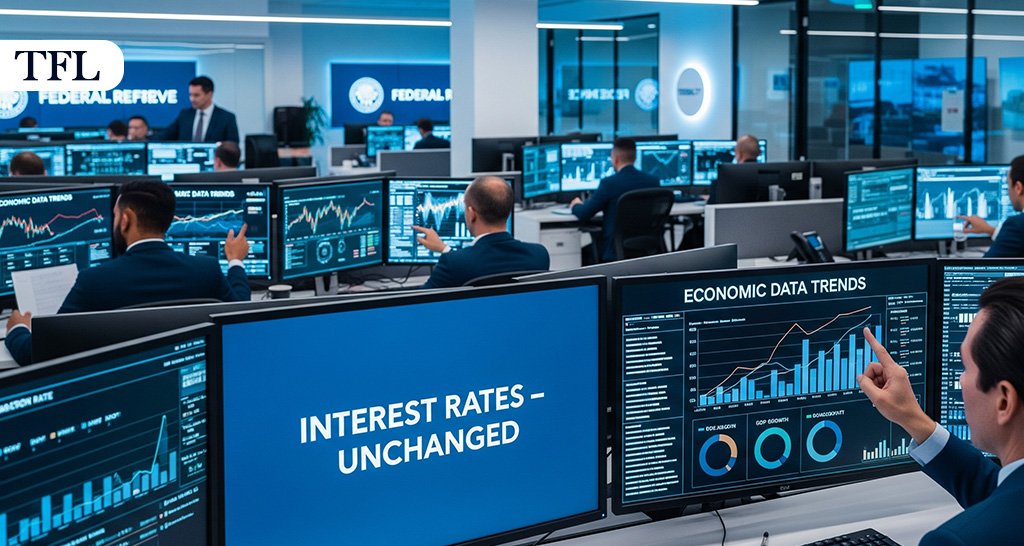
  • Interest Rates Unchanged As Fed Waits On Economic Data

    Interest Rates Unchanged As Fed Waits On Economic Data

    For the fifth consecutive meeting without a rate change, the Federal Reserve declared on July 30, 2025, that it would keep its benchmark federal funds rate between 4.25 and 4.50%. Chair Jerome Powell stressed a cautious, data-driven approach, emphasising that future economic data, not political pressure, will determine interest rates.

    Powell reiterated the Fed’s dedication to independence and policy discipline in the face of mounting pressure from former President Trump and other political leaders to lower rates. He specifically mentioned the uncertainty surrounding tariff-driven inflation and cautioned that taking hasty action could jeopardise long-term price stability.

    Notably, two governors Michelle Bowman and Christopher Waller dissented, urging an immediate quarter-point rate cut due to worries about a contracting labour market. The fact that this is the first dual dissent since 1993 shows how the committee’s internal debate is intensifying.

    A mixed picture emerges from economic indicators: Q2 GDP grew 3%, exceeding projections, but consumer spending is slowing and labour markets are cooling, as evidenced by recent declines in payroll growth. In the meantime, rising tariffs contributed to the Core PCE Price Index, the Fed’s preferred measure of inflation, rising to 2.8% in June, well above its 2% target.

    The market’s reaction was muted: Treasury yields slightly increased and the dollar strengthened, while stocks fell as investors reduced their expectations for a rate cut in September. The likelihood of a cut in September has decreased from almost 65% to roughly 45%, according to analysts including Deutsche Bank.

    Top Fed officials, such as Atlanta Fed chief Raphael Bostic and New York Fed President John Williams, continue to characterise the labour market as strong but cautious, putting more data ahead of changing monetary policy. Later in 2025, if inflation continues to cool and there are additional indications of a soft labour market, the Fed may lower interest rates.

    In conclusion, the Fed’s decision to maintain rates is a result of economic uncertainty that balances growth and inflation risks while reaffirming a methodical, data-driven approach to future policy changes.

  • Wall Street Sees Gains As Trade Deal Optimism Grows Amid Recession Concerns

    Wall Street Sees Gains As Trade Deal Optimism Grows Amid Recession Concerns

    In a surprising turn, Wall Street experienced notable gains this week, buoyed by growing optimism surrounding potential trade deals  even as underlying concerns about a looming recession continue to hover.

    Major indices, including the Dow Jones, S&P 500, and Nasdaq, closed in positive territory, signaling investor confidence fueled by renewed negotiations between key global economic players. Reports suggest that talks have resumed on a more collaborative footing, giving markets the boost they needed after weeks of volatility.

    This uptick comes at a time when many economic indicators from slowing GDP growth to persistent inflationary pressures  are painting a more cautious picture of the broader economic outlook. Analysts warn that while short-term gains are encouraging, the road ahead remains uncertain.

    Nonetheless, traders appear to be betting on diplomacy over discord, with sectors like tech, energy, and manufacturing leading the charge. The renewed optimism has also eased tensions in global markets, with ripple effects seen across European and Asian exchanges.

    For investors, this moment highlights the fine balance between market psychology and macroeconomic realities. While caution remains prudent, the markets are once again reminding us of their resilience and the power of positive sentiment in driving momentum.

    As we move forward, all eyes remain on policy decisions, trade developments, and upcoming economic data that could further shape market direction.

    What’s your take on the recent market movements? Are these gains sustainable, or are we headed for more turbulence?

  • Off-Plan Properties VS. Ready Homes: What Is The Best Investment Strategy?

    Off-Plan Properties VS. Ready Homes: What Is The Best Investment Strategy?

    In the realm of property investment, investors frequently encounter the decision of choosing between off-plan properties and completed homes. Each option presents distinct benefits and challenges, underscoring the importance for prospective buyers to assess their objectives, financial situation, and long-term plans. This blog post will examine the contrasts between off-plan properties and ready homes, offering valuable insights to help you determine the most suitable investment strategy for your requirements.

    What Are Off-Plan Properties?

    Off-plan properties refer to real estate that is marketed and sold prior to its construction or finalization. These properties are primarily conceptual, represented through blueprints or in the initial stages of development, with buyers making investments based on architectural plans, design specifications, and anticipated completion schedules.

    For numerous purchasers, the primary attraction of off-plan properties is the opportunity for capital growth. To entice buyers, developers frequently present lower prices at the beginning of a project, enabling early investors to acquire properties at a reduced rate relative to the market value upon completion of construction. Furthermore, many developers provide flexible payment options, permitting investors to distribute their payments over an extended period.

    The Pros of Off-Plan Properties

    Lower Purchase Prices: Off-plan properties typically come at a lower cost compared to completed homes, presenting a more budget-friendly investment opportunity. Investors have the chance to acquire a property at a favorable price, particularly if they make their purchase early in the development phase.

    Potential for High Returns: In regions with high demand or during periods of market expansion, off-plan properties may see substantial appreciation by the time they become available for occupancy. This presents an opportunity for considerable capital gains.

    Flexible Payment Plans: Developers frequently provide a payment plan that allows buyers to make payments in stages throughout the construction period. This approach can ease the burden of the initial investment, particularly for first-time buyers or individuals who prefer to delay full payment.

    The Cons of Off-Plan Properties

    Construction Delays: A major risk linked to off-plan properties is the possibility of delays. Unexpected challenges, such as supply chain disruptions or regulatory obstacles, can extend the timeline for completion, resulting in investors having to wait longer than anticipated for their property.

    Market Risk: The real estate market may experience considerable fluctuations from the moment of acquisition to the point of finalization. Factors such as economic recessions, alterations in interest rates, or variations in market demand can diminish the expected return on investment.

    No Physical Inspection: As the property is still under development, investors are unable to conduct a physical inspection prior to making a purchase. Consequently, any potential problems related to construction quality, design, or location may only become apparent after the acquisition.

    What Are Ready Homes?

    Ready homes, as indicated by their name, are properties that have been fully constructed and are ready for immediate occupancy. These residences are perfect for buyers seeking to move in swiftly or to begin renting the property for income without the delay of construction.

    The Pros of Ready Homes

    Immediate Occupancy: The primary benefit of ready homes is their immediate availability for occupancy. Whether intended for personal living or investment purposes, buyers can avoid the waiting period associated with construction and the potential for delays.

    Known Condition: In contrast to off-plan properties, completed homes enable buyers to conduct a physical inspection of the property. This eliminates any uncertainty regarding the outcome, allowing investors to evaluate the home’s condition in detail.

    Established Market: Investors can assess the market value of ready homes by examining similar properties in the vicinity. This approach minimizes the likelihood of overpaying or investing in a poorly performing neighborhood.

    The Cons of Ready Homes

    Higher Prices: Properties that are move-in ready typically command a higher price than those sold off-plan. As a result, investors might incur greater costs for a home that has been previously occupied, which could restrict the opportunity for immediate increases in property value.

    Maintenance Costs: Aging homes often entail increased maintenance and repair expenses. As these properties deteriorate over time, the resulting wear and tear can result in extra costs for the new homeowner.

    Limited Customization: In contrast to off-plan properties, completed homes do not offer the opportunity for customization to align with individual tastes or current trends. Buyers receive exactly what is presented, which may not be attractive to everyone.

    Which Is the Best Investment Strategy?

    The decision to invest in off-plan properties versus completed homes primarily hinges on the investor’s objectives, risk appetite, and time frame.

    Off-Plan Properties: For those seeking long-term capital appreciation and who are willing to be patient, investing in off-plan properties could be a more advantageous choice. These properties typically present lower upfront expenses and the possibility of substantial returns; however, they also entail higher levels of uncertainty and risk.

    Ready Homes: For those seeking a more secure investment that offers immediate returns, purchasing ready homes may be an ideal option. These properties present lower risks, as they provide the potential for instant rental income and allow for personal inspection prior to acquisition. Nevertheless, it is important to note that they often entail higher initial expenses and may offer limited chances for substantial appreciation.

    Ultimately, there is no universal solution. An effective investment strategy might incorporate a combination of both off-plan and completed properties, enabling you to take advantage of the benefits offered by each method.

  • How AI Revolutionizes Banking For Smarter Solutions

    How AI Revolutionizes Banking For Smarter Solutions

    The banking sector has experienced significant changes in recent years, largely due to the swift progress in artificial intelligence (AI). AI is fundamentally altering the operations of financial institutions by offering more intelligent solutions that boost efficiency, enhance customer experiences, and refine decision-making processes. This digital transformation is redefining various aspects, from everyday tasks to intricate financial services, resulting in a more agile, responsive, and customer-focused banking environment.

    One of the key advancements brought by artificial intelligence in the banking sector is automation. Conventional banking activities, including transaction processing, identity verification, and customer support, typically demand considerable manual intervention. AI-driven solutions can streamline these operations, minimizing human error and expediting workflows. For instance, AI chatbots have become prevalent in customer service, allowing financial institutions to offer round-the-clock assistance. These chatbots are capable of addressing various inquiries, such as checking account balances and aiding in loan applications, thereby enabling human representatives to concentrate on more intricate issues.

    AI is revolutionizing the methods by which banks evaluate risk and determine lending decisions. Historically, banks have depended on fixed credit scores to assess loan applicants. In contrast, AI technologies can process extensive data from diverse sources, including transaction records, social media interactions, and market dynamics, to deliver a more comprehensive and precise understanding of a borrower’s financial status. This capability enables banks to create tailored loan offerings and make better-informed lending choices, thereby minimizing the likelihood of defaults and enhancing credit accessibility for marginalized groups.

    AI is also significantly impacting the fields of fraud detection and cybersecurity. Through the use of AI algorithms, it is possible to monitor transactions continuously for any irregular patterns and to identify potential fraudulent activities in real-time. By examining historical data and learning from previous occurrences, AI systems enhance their ability to detect and prevent fraud, thereby increasing the security of banking for both financial institutions and their clients.

    Furthermore, artificial intelligence is empowering financial institutions to provide personalized services. By utilizing machine learning algorithms, banks are able to assess customer behavior and preferences, allowing them to present customized products, including personalized investment advice and savings strategies. These insights driven by AI improve customer satisfaction, resulting in a more cohesive and pertinent banking experience.

    In summary, artificial intelligence is transforming the banking sector by improving operational efficiency, bolstering security measures, and facilitating more tailored financial services. As this technology advances, it is anticipated to further reshape the industry, providing more intelligent solutions for banks and their clientele.

  • The Use Of Cutting-Edge Data Analytics Services To Maximise ROI

    The Use Of Cutting-Edge Data Analytics Services To Maximise ROI

    Utilising state-of-the-art data analytics services is essential for companies looking to optimise their return on investment (ROI) in today’s data-driven world. These cutting-edge services assist businesses in transforming unprocessed data into useful insights that inform strategy and improve operational effectiveness. This is how to increase ROI by utilising data analytics.

    Leverage Predictive Analytics

    To predict future patterns, predictive analytics makes use of statistical algorithms and previous data. Businesses can improve return on investment (ROI) by making proactive decisions that are in line with their strategic goals by anticipating customer behaviour, market trends, and potential dangers. Retailers, for example, can cut waste and optimise inventory levels by improving their demand forecasting.

    Implement Real-Time Analytics

    Businesses may watch and study data as it is generated with real-time analytics. This instantaneity makes it possible to react quickly to new problems or possibilities. Real-time analytics, for instance, can improve consumer experience in e-commerce by instantly personalising offers and promotions, and it can assist traders in the financial markets in making informed decisions.

    Utilize Big Data Technologies

    Large data processing and analysis are made possible for organisations by big data technologies like Hadoop and Spark. Large datasets may be mined for insightful information using these technologies, which can then be used to improve customer targeting, drive innovation, and influence strategic planning all of which can result in higher return on investment.

    Adopt Data Visualization Tools

    Complex data is transformed into comprehensible and interactive visual formats by data visualisation technologies. With the use of these technologies, decision-makers can more easily comprehend trends, patterns, and anomalies, enabling them to make well-informed choices that can improve ROI and operational performance.

    Businesses can improve performance, obtain a competitive edge, and maximise returns on investment by integrating these state-of-the-art data analytics services.

  • The Home Insurance Model And Climate Risk: Adjusting To A Changing Environment

    The Home Insurance Model And Climate Risk: Adjusting To A Changing Environment

    In response to the growing risks connected with these changes, house insurance models are changing as climate change has a greater impact on weather patterns and natural disasters. Climate risk is dynamic, which puts traditional insurance models to the test. Static risk assessments and historical data were the foundations of traditional insurance models.

    The Emerging Climate Risk

    Climate risk encompasses a range of environmental threats, including extreme weather events such as hurricanes, floods, wildfires, and heat waves. These events are becoming more frequent and severe, leading to significant property damage and higher insurance claims. As a result, insurers must adapt their models to better predict and manage these risks.

    Adapting the Insurance Model

    Enhanced Risk Assessment

    Predictive analytics and sophisticated climate data are being included in modern house insurance models to improve risk assessment. Insurers can gain a better understanding of the possible effects of climate-related events on properties by utilising satellite imagery, climate models, and historical data.

    Dynamic Pricing

    Risk assessments and real-time climate data are increasingly being used to modify insurance prices. Properties with robust features or those located in lower-risk locations may qualify for cheaper premiums, while homes in high-risk zones can pay higher premiums.

    Incentives for Resilience

    Enhancing a property’s resistance against climate threats is something that insurers are encouraging and rewarding. Discounts for houses with wildfire-resistant construction, flood barriers, or other risk-reducing elements are included in this.

    Comprehensive Coverage Options

    Insurers are providing more extensive coverage options that include protection against particular climate-related catastrophes, such as an earthquake or flooding coverage, to handle a variety of climate hazards.

    Conclusion

    As a result of climate change, the house insurance market is drastically changing. Insurers are better able to control climate risk and safeguard homes in a more unstable environment by implementing resilience incentives, dynamic pricing schemes, and sophisticated risk assessment techniques.